Explore All Treatments
Other Surgeries by Dr. Sujeeth Kumar Bashetty
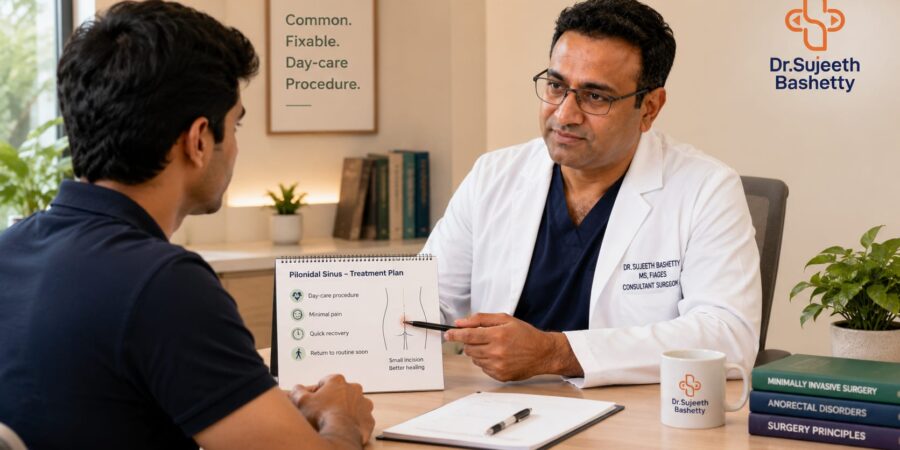
Pilonidal Sinus Surgery in Hyderabad — Minimally Invasive, Long-Lasting Relief
A pilonidal sinus is a small cyst or abscess that forms at the top of the buttock cleft (near the tailbone), typically containing hair, skin debris, and bacteria. Left untreated, it causes persistent pain, swelling, and recurring infections. Surgical removal is the only definitive cure.
Dr. Sujeeth Kumar Bashetty at Apollo Hospitals, Hyderabad, specialises in minimally invasive pilonidal sinus surgery — offering faster recovery, less post-operative pain, and significantly lower recurrence rates than conventional open surgery.
Understanding Pilonidal Sinus
A pilonidal sinus develops when hair penetrates the skin and becomes embedded under it, causing a foreign body reaction and subsequent infection. It most commonly affects young adults and people who sit for prolonged periods.
Symptoms
✓ Painful swelling or lump near the top of the buttock cleft
✓ Discharge of pus or blood from a small opening in the skin
✓ Foul-smelling discharge
✓ Redness and tenderness around the area
✓ Recurrent pain and abscess formation
✓ Fever or malaise during acute infection episodes
Types of Pilonidal Disease
Acute Pilonidal Abscess
A painful, swollen collection of pus requiring immediate incision and drainage. This provides quick relief but does not cure the underlying sinus tract.
Chronic Pilonidal Sinus
A persistent sinus tract with intermittent discharge, pain, and recurrent abscess formation. Requires definitive surgical excision for lasting cure.
Complex / Recurrent Pilonidal Disease
Multiple sinus tracts or a sinus that has recurred after previous surgery. Requires a more extensive approach such as flap reconstruction.
Treatment Options
Minimally Invasive Sinusectomy (EPSIT / SiLaC)
An endoscopic or laser technique that removes the sinus tract through a very small incision. Minimal tissue disruption, no large open wound, and return to normal activities within days.
Wide Excision and Primary Closure
The sinus and surrounding tissue are removed and the wound is closed directly. Effective for straightforward cases with low recurrence when closed off-midline.
Flap Procedures (Karydakis / Limberg)
Tissue flap techniques that flatten the natal cleft and reposition the scar away from the midline, dramatically reducing the chance of recurrence. Recommended for complex or recurrent disease.
Why Choose Minimally Invasive Pilonidal Surgery?
✓ No large open wound — significantly reduced post-operative discomfort
✓ Same-day or next-day discharge for most patients
✓ Return to sitting and normal activities within 3–7 days
✓ Low recurrence rate with experienced surgical technique
✓ No prolonged wound dressing and home nursing requirements
Frequently Asked Questions
Q: Will the pilonidal sinus come back after surgery?
A: Recurrence depends on the surgical technique used and patient factors such as hair growth and hygiene. Minimally invasive and off-midline techniques have significantly lower recurrence rates than conventional open excision left to heal by secondary intention.
Q: How long does recovery take?
A: With minimally invasive surgery, most patients return to desk work within 3–5 days. Vigorous activity and prolonged sitting should be avoided for 2–3 weeks.
Q: Is the procedure done under general anaesthesia?
A: Most pilonidal sinus procedures are performed under spinal or local anaesthesia with sedation as a day-case procedure. General anaesthesia is used for more extensive operations.
Q: Does laser hair removal help prevent recurrence?
A: Yes. Laser hair removal around the natal cleft after surgery significantly reduces the risk of sinus recurrence by eliminating the primary cause — embedded hair.
Book Your Consultation — Apollo Clinic Manikonda, Hyderabad (surgery at Apollo Hospitals, Jubilee Hills)
Call 9963009090 | WhatsApp Us
Related Services: Piles Surgery | Fistula Surgery | General Surgery
Pilonidal Sinus — explained by Dr. Sujeeth
Short videos from Dr. Sujeeth on pilonidal sinus, causes, and modern treatment. From the YouTube channel @dr.sujeeth (26,500+ subscribers).