Thyroid Surgery in Hyderabad — Expert Care by Dr. Sujeeth Kumar
What Thyroid Patients Say
Verified Google reviews from Dr. Sujeeth Kumar’s 4.9★ rating (117+ patients)
“Dr. Sujeeth Kumar listens to you very patiently and gives sufficient time. He diagnosed in no time and helped me change my lifestyle habits. One of the best doctors I have visited.”
“Very good doctor, dedicated towards his profession and always cares for his patients. Recommends surgery only when it is really required. Very rare kind of metal among present generation doctors.”
“Dr Sujeeth connects with his patients at a personal level which gives significant reassurance. Very honest and positive approach in treatment — a rarity in the highly commercialized medical fraternity.”
Explore All Treatments
Other Surgeries by Dr. Sujeeth Kumar Bashetty
Thyroid Surgery (Thyroidectomy) in Hyderabad — Expert Surgical Care
The thyroid gland regulates metabolism, energy, and hormone balance throughout the body. When it develops nodules, enlarges significantly, or becomes cancerous, surgical removal — a thyroidectomy — may be necessary. Dr. Sujeeth Kumar Bashetty at Apollo Hospitals, Hyderabad, performs thyroid surgery with meticulous precision to protect surrounding nerves and glands while achieving complete disease control.
When Is Thyroid Surgery Recommended?
✓ Thyroid nodules that are suspicious or confirmed malignant on biopsy
✓ Thyroid cancer (papillary, follicular, medullary, or anaplastic)
✓ Large goitre causing difficulty swallowing, breathing, or a cosmetic concern
✓ Hyperthyroidism (overactive thyroid) not responding to medication or radioiodine
✓ Substernal goitre extending into the chest
✓ Indeterminate biopsy results requiring surgical assessment
Types of Thyroid Surgery
Hemithyroidectomy (Lobectomy)
Removal of one lobe of the thyroid gland. Used for a single suspicious nodule or unilateral cancer. The remaining lobe usually maintains adequate thyroid hormone production, often avoiding lifelong hormone replacement.
Total Thyroidectomy
Complete removal of the thyroid gland. Required for thyroid cancer, large bilateral goitre, or Graves’ disease. Lifelong thyroid hormone replacement (thyroxine) is needed post-operatively.
Near-Total / Subtotal Thyroidectomy
Removal of most of the thyroid gland while leaving a small remnant. Less commonly performed today but used in selected cases of benign multinodular goitre.
The Surgical Procedure
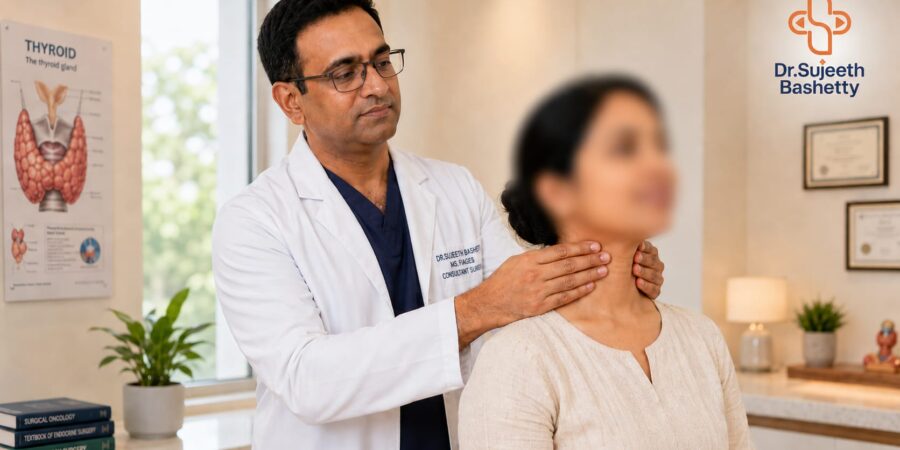
Thyroidectomy is performed under general anaesthesia through a small, horizontal incision in the lower neck — placed carefully in a natural skin crease to minimise visible scarring. The thyroid is carefully dissected away from the recurrent laryngeal nerves (which control voice) and the parathyroid glands (which control calcium balance). Intraoperative nerve monitoring is used to protect voice function throughout the procedure.
Why Choose Dr. Sujeeth Kumar Bashetty?
✓ Meticulous nerve identification and preservation — protecting voice and parathyroid function
✓ Intraoperative nerve monitoring for every case
✓ Expert management of both benign and malignant thyroid disease
✓ Coordination with endocrinology and oncology for comprehensive cancer care
✓ Minimal visible scarring with precise wound closure technique
Frequently Asked Questions
Q: Will I need to take medication after thyroid surgery?
A: After a total thyroidectomy, lifelong thyroxine (T4) replacement is required. After a hemithyroidectomy, about 75–80% of patients do not need hormone replacement, as the remaining lobe compensates.
Q: Is there a risk to my voice after thyroid surgery?
A: Temporary voice hoarseness is common for a few days post-operatively due to intubation and surgical dissection. Permanent voice changes are rare (less than 1%) when surgery is performed by an experienced thyroid surgeon using nerve monitoring.
Q: How long is the recovery?
A: Most patients are discharged 1–2 days after surgery. Light activities can resume within a week. Strenuous activity and heavy lifting should be avoided for 3–4 weeks.
Q: What follow-up is needed after thyroid cancer surgery?
A: Follow-up includes thyroglobulin blood tests, neck ultrasound, and in some cases radioiodine ablation — coordinated with the endocrinology team.
Book Your Thyroid Surgery Consultation — Apollo Clinic Manikonda, Hyderabad (surgery at Apollo Hospitals, Jubilee Hills)
Call 9963009090 | WhatsApp Us
Related Services: General Surgery | Laparoscopic GI Surgery | All Treatments
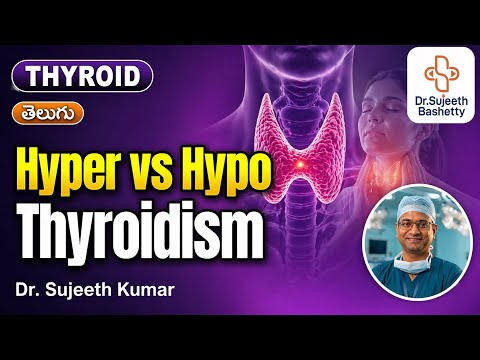
Thyroid — explained by Dr. Sujeeth
Short videos from Dr. Sujeeth on hyperthyroidism, hypothyroidism, and when surgery is needed. From the YouTube channel @dr.sujeeth (26,500+ subscribers).