GERD Treatment in Hyderabad — Lasting Relief from Acid Reflux
Explore All Treatments
Other Surgeries by Dr. Sujeeth Kumar Bashetty
GERD Treatment in Hyderabad — Surgical Solutions for Lasting Relief
Gastroesophageal Reflux Disease (GERD) is a chronic condition in which stomach acid regularly flows back up into the oesophagus, causing a range of uncomfortable and potentially damaging symptoms. While many patients manage GERD with lifestyle changes and medication (proton pump inhibitors), a significant number of patients continue to suffer despite medical treatment — or prefer a permanent surgical solution over lifelong medication.
Dr. Sujeeth Kumar Bashetty at Apollo Hospitals, Hyderabad, is an experienced specialist in laparoscopic anti-reflux surgery, offering patients long-term freedom from GERD symptoms and medication dependence.
Understanding GERD — Symptoms
✓ Heartburn — a burning sensation in the chest, especially after eating or lying down
✓ Regurgitation — sour or bitter fluid rising into the throat or mouth
✓ Difficulty or discomfort swallowing (dysphagia)
✓ Chronic cough, hoarseness, or throat clearing
✓ Feeling of a lump in the throat
✓ Chest pain (must be distinguished from cardiac causes)
✓ Worsening asthma due to acid microaspiration
✓ Dental erosion from chronic acid exposure
What Causes GERD?
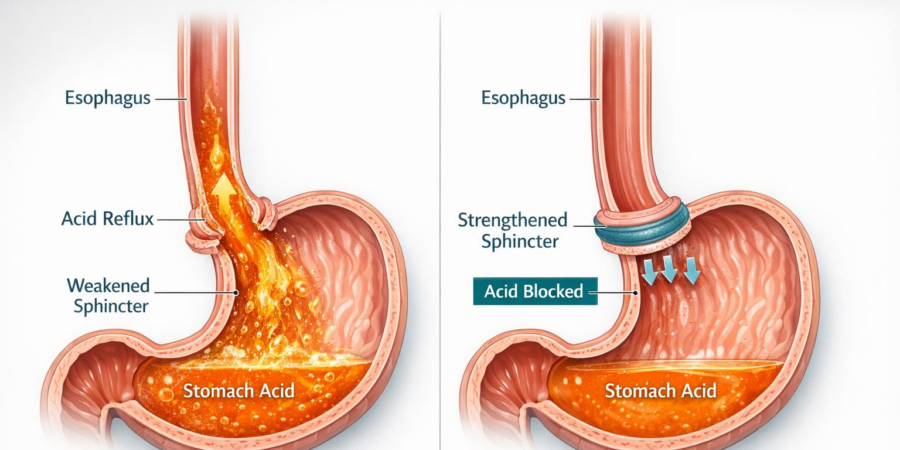
GERD occurs when the lower oesophageal sphincter (LOS) — the valve between the oesophagus and stomach — becomes weakened or relaxes inappropriately, allowing acid and stomach contents to flow upward. Contributing factors include hiatus hernia, obesity, pregnancy, certain foods, and medications.
When Is Surgery Recommended?
✓ Symptoms persist or recur despite optimal medical therapy
✓ Patient preference to avoid lifelong medication
✓ Significant oesophagitis (Grade C or D) on endoscopy
✓ Barrett’s oesophagus with associated reflux symptoms
✓ Large hiatus hernia causing GERD or other symptoms
✓ Extra-oesophageal symptoms (cough, hoarseness) not responding to PPIs
Surgical Treatment — Laparoscopic Fundoplication
Nissen Fundoplication (360° Wrap)
The most commonly performed anti-reflux operation. The upper part of the stomach (fundus) is wrapped completely around the lower oesophagus, reinforcing the LOS and creating a valve mechanism that prevents reflux. Performed laparoscopically through 5 small incisions. Highly effective — over 90% of patients report significant or complete resolution of reflux symptoms.
Toupet Fundoplication (270° Partial Wrap)
A partial wrap used in patients with impaired oesophageal motility, to reduce the risk of post-operative dysphagia while still providing excellent reflux control.
Hiatus Hernia Repair
When a hiatus hernia is present, it is repaired simultaneously during fundoplication — the stomach is returned to the abdomen and the hiatus (opening in the diaphragm) is reinforced with sutures, sometimes with a mesh.
Benefits of Laparoscopic Anti-Reflux Surgery
✓ Over 90% long-term success rate in appropriately selected patients
✓ Freedom from daily medication for most patients
✓ Rapid recovery — most patients discharged within 24–48 hours
✓ Minimal scarring with laparoscopic technique
✓ Prevents long-term complications of untreated GERD (Barrett’s oesophagus, stricture)
✓ Significant improvement in quality of life
Frequently Asked Questions
Q: How do I know if I need surgery for GERD?
A: Surgery is recommended if your symptoms are inadequately controlled on maximum medical therapy, if you have a large hiatus hernia, or if you wish to stop long-term medication. A 24-hour pH study and oesophageal manometry are typically performed before surgery to confirm the diagnosis and assess oesophageal motility.
Q: Will I still need medication after anti-reflux surgery?
A: The majority of patients (90%+) are able to stop acid-suppressing medication entirely after successful fundoplication. A small proportion may require occasional or low-dose medication.
Q: What are the risks of fundoplication?
A: The main risk of Nissen fundoplication is post-operative difficulty swallowing (dysphagia), which typically resolves within a few weeks. Bloating and difficulty belching are also common initially. Serious complications (bleeding, injury to adjacent structures) are rare in experienced hands.
Q: How long does recovery take?
A: Most patients are discharged 1–2 days after laparoscopic fundoplication. A soft diet is recommended for 4–6 weeks while the wrap settles. Return to office work is typically possible within 1–2 weeks.
Book Your GERD Consultation — Apollo Hospitals, Jubilee Hills, Hyderabad
Call 9963009090 | WhatsApp Us
Related Services: Laparoscopic GI Surgery | Gastric Surgery | Esophageal Surgery